
TL;DR
For service-based small and midsize businesses, missed phone calls are not a minor inconvenience – they are one of the largest hidden sources of lost revenue. Research consistently shows that most callers who reach voicemail never try again. AI call agents ensure every call is answered, qualified, and captured, turning previously lost demand into measurable growth without adding headcount.
Why Missed Phone Calls Are a Silent Revenue Leak
Missed calls are one of the most underestimated operational failures in SMBs. Each unanswered phone call represents a prospect with clear intent, time sensitivity, and budget readiness. When that call goes to voicemail, the opportunity often disappears permanently.
Unlike email or web forms, phone calls usually happen at the exact moment a customer wants to act: booking an appointment, requesting a quote, or resolving an urgent issue. Failing to answer at that moment creates friction that modern buyers simply avoid.
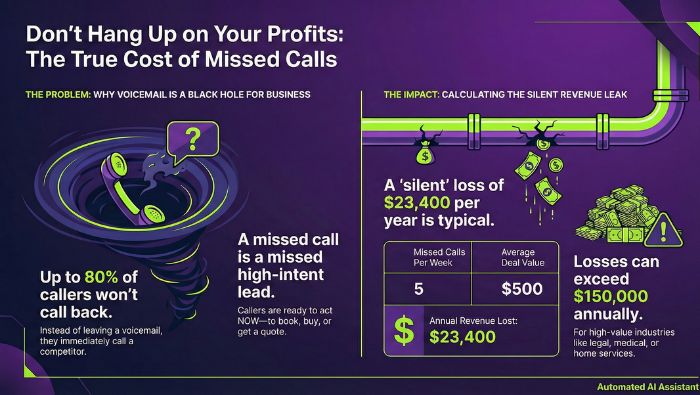
Multiple industry studies across local services and healthcare indicate that 60–80% of callers who reach voicemail do not call back, choosing a competitor instead. This behavior turns every missed call into a near-certain lost sale.
How Much Does a Missed Call Actually Cost?
Even a small number of missed calls can have an outsized financial impact.
A Conservative Revenue Loss Scenario
Consider a realistic example for a service-based SMB:
- Missed calls per week: 5
- Calls that are qualified leads: 60%
- Close rate on qualified leads: 30%
- Average deal value: $500
Weekly revenue lost: $450
Annual revenue lost: $23,400
In higher-value industries such as legal services, home services, medical practices, or B2B consulting, the same math often exceeds $50,000–$150,000 per year.
Because this loss does not appear in standard financial reports, it often goes unnoticed and unresolved.
Why Voicemail No Longer Works for Modern Buyers
Voicemail was designed for a different era of customer behavior. Today’s buyers expect speed, clarity, and minimal effort.
When a call goes to voicemail, callers often:
- Assume the business is unavailable or overwhelmed
- Expect slow or inconsistent follow-up
- Move on to the next provider who answers immediately
Even when voicemails are left, they introduce delays. Staff must listen, transcribe, prioritize, and return calls – often hours later. By that time, the buying window has closed.
Why “Just Hiring More Staff” Is an Expensive Fix
Many SMBs attempt to solve missed calls by adding receptionists or extending coverage hours. While this can help, it introduces new challenges:
- Higher payroll, benefits, and management costs
- Training time and employee turnover
- Limited coverage during nights, weekends, and call spikes
- Inconsistent call handling quality
This approach scales costs linearly, while call volume often fluctuates unpredictably.
How AI Call Agents Eliminate Missed Call Revenue Loss
AI call agents take a fundamentally different approach. Instead of relying on human availability, they ensure every call is answered instantly, consistently, and intelligently.
What an AI Call Agent Does
A properly configured AI call agent can:
- Answer 100% of inbound calls, 24/7
- Greet callers using your brand voice
- Ask structured qualifying questions
- Book appointments or capture lead details in real time
- Route urgent or complex calls to a human
- Log call data directly into CRMs or scheduling tools
The result is not only fewer missed calls, but higher-quality lead capture and faster conversion cycles.
Revenue Recovery in Real Terms
Returning to the earlier example, recovering just five missed calls per week can generate over $20,000 in annual revenue. For many SMBs, AI call automation pays for itself within weeks, not months.
This is why AI call agents are increasingly viewed not as a support tool, but as a revenue system.
When AI Call Automation Delivers the Highest ROI
AI call agents are most effective in businesses where phone calls are directly tied to revenue, including:
- Home services and trades
- Medical, dental, and wellness practices
- Legal and professional services
- Real estate and property management
- B2B service providers with inbound leads
If phone calls are how customers book, quote, or close, missed call automation is no longer optional.
From Cost Center to Conversion Engine
Historically, call handling was treated as an operational expense. AI transforms it into a conversion engine that works continuously, without fatigue or scheduling gaps.
By answering every call, qualifying intent, and capturing structured data, AI call agents turn inbound demand into predictable growth.
Frequently Asked Questions
How many missed calls are normal for a small business?
Industry benchmarks suggest that many SMBs miss 10–30% of inbound calls, especially during peak hours, lunch breaks, evenings, and weekends. Businesses with lean teams or high call volumes tend to miss even more.
Do AI call agents replace human receptionists?
Not necessarily. Many businesses use a hybrid model, where AI handles first contact, qualification, and scheduling, while humans focus on complex conversations and high-value interactions.
What industries benefit most from AI call answering?
Industries with urgent, high-intent calls see the highest ROI, including healthcare, home services, legal services, real estate, and B2B services. In these sectors, a single missed call can represent hundreds or thousands of dollars.
How does AI handle compliance and call recording laws?
Modern AI call agents support consent prompts, call recording disclosures, logging, and regional compliance requirements. Businesses should configure agents based on local and industry-specific regulations.
Can AI call agents integrate with existing CRMs and calendars?
Yes. Most AI call agents integrate with popular CRMs, scheduling tools, and booking systems, allowing calls to automatically create leads, appointments, and follow-up tasks without manual entry.
Next Steps
If your business relies on inbound phone calls, missed calls represent revenue you have already paid to generate. AI call agents provide a scalable way to capture that demand, improve customer experience, and unlock growth without expanding headcount.




0 Comments