
Executive Summary
Modern organizations are facing a structural productivity problem, not a talent shortage. Teams are overloaded with operational work, attention is fragmented across systems, and growth is constrained by human throughput rather than market demand. Hiring more people into these conditions compounds cost and burnout without fixing the root cause.
The solution is not replacing humans, it is redesigning work. AI business systems now operate reliably enough to function as permanent operational employees, handling repeatable, high-volume tasks so humans can focus on judgment, creativity, and leadership. Companies that treat AI as a core workforce layer, not a tool experiment, gain durable competitive advantages in speed, cost structure, and resilience.
Key Takeaways
- AI systems eliminate operational burnout by handling continuous, repetitive work without fatigue or context loss.
- AI outperforms human labor in system work, operating 24/7, scaling instantly, and improving through feedback loops.
- The real ROI of AI is reclaimed human focus, not just cost reduction.
- Winning organizations build hybrid workforces, where humans lead and AI executes.
The Hidden Cost of Human-Centered Operations
Most businesses still rely on people to perform work that is fundamentally mechanical. Inbox management, data entry, lead qualification, reporting, scheduling, customer triage, and internal follow-ups quietly consume thousands of hours each year.
This model creates compounding costs:
- Mental fatigue reduces accuracy and decision quality
- Burnout increases turnover, hiring, and training expenses
- Bottlenecks form around routine approvals and handoffs
- Growth becomes limited by headcount instead of demand
Humans are not failing businesses. Businesses are failing humans by forcing them to operate like machines inside machine-paced systems.
AI Systems Are Not Tools, They Are Operational Employees
Traditional software behaves like a tool: it waits for input and performs a narrow function. A true AI business system behaves like an employee embedded into operations.
A well-designed AI system can:
- Receive inputs from multiple channels
- Apply rules, probabilities, or learned patterns
- Execute workflows across platforms
- Escalate edge cases to humans
- Learn from outcomes and feedback
Unlike human labor, AI systems do not experience fatigue, distraction, or diminishing returns. Once deployed and governed correctly, they become permanent contributors to operational reliability.
AI vs Human Employees: A Practical Comparison
| Capability | Human Employee | AI System |
|---|---|---|
| Availability | Limited working hours | 24/7/365 |
| Consistency | Varies with fatigue | Fully consistent |
| Scalability | Linear with hiring | Instant and elastic |
| Error Rate | Increases under stress | Predictable and reducible |
| Training Time | Weeks to months | Days to deploy |
| Cost Structure | Salary plus overhead | Fixed or usage-based |
This comparison is not about replacement. It is about alignment. Humans should do human work. Systems should do system work.
From Emotional Fatigue to Automation Freedom
Modern work quietly demands constant context switching: monitoring tools, responding to alerts, remembering processes, and reconciling data across systems. Over time, this creates cognitive overload.
AI-driven automation changes the emotional equation:
- No constant task switching
- No inbox-driven urgency
- No manual reconciliation or follow-ups
- No human monitoring of machine-paced workflows
The result is automation freedom. Teams move from reactive execution to intentional decision-making, improving both performance and morale.
Where AI Systems Deliver Immediate ROI
AI systems deliver the fastest impact when applied to repeatable workflows with clear inputs, outputs, and escalation paths.
High-impact use cases include:
- Sales lead intake, qualification, and routing
- Customer support triage and resolution
- Finance operations, invoicing, and reconciliation
- Marketing performance reporting and attribution
- Internal knowledge retrieval and documentation
In each case, AI reduces cycle time, improves consistency, and unlocks scale without proportional cost increases.
The Strategic Advantage of Treating AI as an Employee
Organizations that treat AI as a strategic hire, rather than a tactical experiment, gain compounding advantages:
- Faster response times across the organization
- Lower dependency on headcount growth
- Higher resilience during demand spikes
- More engaged human teams focused on value creation
Over time, these advantages reshape how growth is achieved. AI systems do not just support scale, they redefine it.
Implementation: From Concept to Operational Asset
Successful AI adoption follows a disciplined progression:
- Identify processes that drain human energy but require low judgment
- Map inputs, outputs, rules, and exception paths
- Assign clear operational ownership for the AI system
- Deploy with measurable performance benchmarks
- Continuously optimize based on real-world outcomes
The goal is not novelty. The goal is reliability.
The Future Workforce Is Hybrid by Design
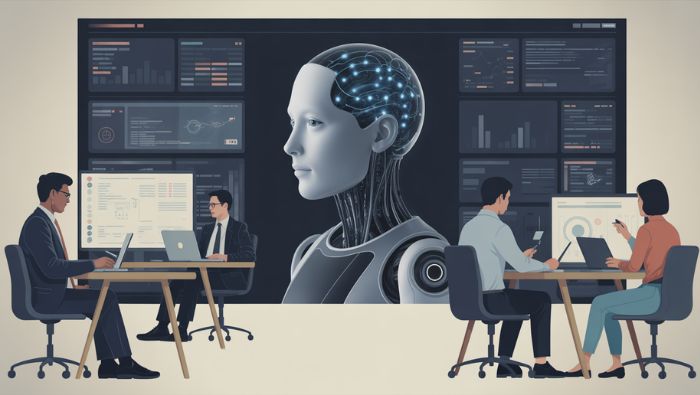
The most competitive organizations will not choose between humans and AI. They will architect hybrid workforces where AI systems form the operational backbone and humans focus on leadership, creativity, and complex decision-making.
Humans will lead, design, and decide. AI systems will execute, monitor, optimize, and scale.
This is not a distant future. It is an available advantage.
Frequently Asked Questions
What tasks should businesses automate first with AI?
Start with high-volume, repeatable workflows that have clear inputs and outputs. Prioritize processes that cause burnout but add little strategic value, such as triage, data movement, reporting, and routine customer interactions.
How much does an AI business system cost compared to hiring?
Costs vary by complexity, but AI systems typically replace the output of multiple full-time roles at a fraction of the long-term cost. Most organizations reach break-even within months once deployment and training are complete.
What risks exist when replacing human tasks with AI?
Risks include poor governance, unclear ownership, and over-automation of judgment-heavy decisions. These are mitigated through clear escalation rules, human oversight, auditability, and ongoing monitoring.
How do AI systems integrate with existing software stacks?
Most AI systems integrate through APIs, webhooks, and orchestration layers. They sit above existing tools, coordinating workflows rather than replacing core systems of record.
Can small businesses benefit from AI employees?
Yes. Small teams often benefit the most because AI removes operational drag early. Scaled-down deployments and phased adoption allow small businesses to compete with much larger organizations.
Final Thought
Your best employee does not need sleep, does not burn out, and does not forget process. When designed correctly, AI systems become the most reliable operational contributors in your organization, freeing humans to do what only humans can do.




0 Comments